


🎧 Please listen to the audio using the player above.☝️
In the seventh episode of the Nectar of Peace podcast, we will explore the definition and, at the same time, the important difference between the concepts of duty and obligation. A good and correct understanding of these two concepts is actually more important than it may initially seem. In brief, we will also touch on the concept of spontaneity and why it can be a significant source of peace, contentment, and balance in the life of anyone who knows how to live it.
What you’ll hear in this episode:
Two ways of living
The importance of spontaneity and responsibility
The difference between duty and obligation
Why duties YES, while obligations NO
Lao Tzu and Wu Wei, or effortless action
An invitation to freedom
My name is Mitja Žibert, and I’ll be your host on this podcast, which serves as an invitation to personal and spiritual growth.
Sources:
Novo: Lectures and Q&A archive
Jiddu Krishnamurti: Life Ahead: On Learning and the Search for Meaning
If this episode resonated with you, consider sharing it with friends or loved ones - you might just help someone on their path.
Episode transcription
Welcome to the Nectar of Peace podcast, which is dedicated to sharing universal truths and wisdom taught by humanity’s greatest teachers and sages.
My name is Mitja Žibert, and I’ll be joining you in discovering these invaluable teachings that, if we choose to follow them, lead us to a life filled with the nectar of peace - which is what we all seek and need.
So, let’s see where we can discover and embrace it today.
In life, we entangle ourselves far too much. We get entangled in relationships and activities that later bring about consequences we often don’t want to face or accept.
That is why, in today’s episode, I’ve prepared some teachings that can significantly protect us from this unnecessary entanglement and the consequences that come with it. Specifically, we’ll be talking about duties and obligations, and why one is essential for humans while the other is not.
Clearly distinguishing between these two concepts is extremely important, as they are often considered the same thing, which greatly contributes to the all-present human confusion.
Closely related to this, we’ll also touch on the concept of spontaneity for the first time. A topic to which we’ll also be returning in future episodes.
For clarification and guidance for these topics, I’ve again turned to teacher Novo. And, in direct connection with what Novo shared, I’ve also briefly referred to two other great sages, that is Lao Tzu and Jiddu Krishnamurti.
So, let’s dive straight into the exploration of the meaning of duty, obligation, and spontaneity. Novo began his answer like this:
Teachings
»Life can be lived in two ways: spontaneously or through free will, meaning by initiating action. Living spontaneously, or through observation, means that you react only when you’re compelled to do so from the outside. In other words, when something external compels you to respond, that is called a spontaneous way of living.
However, when you start involving yourself in circumstances or entering them on your own, this is referred to as a willful, deliberate, or active way of living. This means, you are using your will.
In a spontaneous way of living, the following things are included:
For example, when a person is sitting calmly and a strong stream of water rushes toward them, they move aside. They were sitting still, but when the water came, they moved. If there had been no water, they wouldn’t have moved. This is called spontaneously responding to a situation. Or, for instance, someone is sitting in the middle of the road and a car is coming toward them. They get out of the way. If the car hadn’t come, they would have kept sitting there.
Another situation: someone calls them and they respond.
A third: they feel cold, so they put on some clothes. Similarly, when they’re warm, they take some off.
Or, for example, when it’s cloudy, a person opens their umbrella only when it starts to rain.
This kind of action is called a spontaneous way of living. There are, of course, countless other examples. One more such example is: speak only when you are asked. That too is spontaneity.«
Let me add here that Novo used a few simple, even exaggerated examples of spontaneous living to make the concept easier to grasp. Of course, it is unlikely that we will ever find ourselves sitting in the middle of a road or with a torrent of water rushing toward us. But this very exaggeration highlights the simplicity of spontaneity itself, which means a complete surrender to circumstances, allowing them to entirely guide us through life. We merely respond to them, without interference from our own will.
A spontaneous way of living is often mistaken for laziness or a sort of a hippie behavior, but it has nothing to do with that. True spontaneous living is the most natural, grounded, and balanced way of life, because it means wholeheartedly responding to whatever life brings, and at the same time not engaging ourselves based on our will. And all this unfolds moment by moment, without planning or desiring.
In practice, this means that when a person becomes calm and still, they can clearly recognize what life itself brings to them in that moment. Meaning, what they are meant to do or respond to in that moment - without initiating, provoking, or wishing for anything. And that which life brings is always an answer to our true needs. And that with which life confronts us is always a consequence of our past, which we must resolve.
Such a way of living, however, is quite foreign to the modern human, since it is hard to imagine a life without following the impulses of our mind or habits, or the pressures and conditioning of society.
And what we mostly live today, that which is the complete opposite of spontaneity, Novo described as follows:
»An active way of living is when a person initiates something on their own or uses their own will. For example, they go outside and do not like how something is arranged, so they decide to change it. There’s a car standing there, and they move it. If they were spontaneous, they would simply walk past the car, because it would not bother them. However, the moment they wish to change something, it means they will use their own will. This, therefore, is a way of living that involves intentions, desires, seeking, and influencing.
As we said, a person goes outside, is disturbed by a car, and moves it. Or they see something else they do not like and react. They walk past a restaurant, see some food, and say, “I will also order this.” Or they go out on a sunny day and take an umbrella with them, just in case it starts to rain. In other words, they influence the existing situation.
Such a way of living is living according to will, or a way of life in which a situation is influenced. It can therefore be said that such a way of living is living according to one’s desires or one’s intentions.
And a way of living in which a person wants to live according to their desires, intentions, and their activity always carries consequences. The consequences are therefore inevitable. While the other way of living doesn’t carry consequences, because you merely respond and adapt, thereby protecting yourself. But in the active way of living, you create changes. And whenever you cause changes, consequences inevitably follow.
Thus, it follows that if you want a car, you must then take care of that car. If you want something else, for example clothing, you must also take care of it. If you want a house, you must invest in it and maintain it.
Therefore, when we accept such an active way of living, or a life based on intentions and plans, this is called the ability to bear responsibility.
So, what does it mean to bear responsibility? When you begin to live in this way, you accept responsibility for all the consequences. No matter who does wrong. When you are the first to initiate a change in your surroundings, and because of this change consequences arise, then you are the one who bears responsibility. You may argue that you only began, but it was the other person who did wrong. But the one who begins is always accountable.
The awareness that the one who initiates is responsible for all the consequences is called responsibility. In other words, you realize that you must inevitably bear the consequences. And those consequences are yours.
Therefore, the ability to accept consequences is called responsibility. Let me repeat: the ability to accept consequences is called responsibility.«
And as we’ve learned in previous episodes, our actions and their consequences can also be called karma. In light of Novo’s words, it is worth remembering that the word responsibility also means that, when karma comes to us in any given moment, we fully accept and settle it, with the awareness that it is merely the result of our past decisions and related actions or our way of living.
In other words, a truly responsible person is one who calmly and without resistance accepts and resolves the consequences of their actions, that is, their karma.
And closely related to all of this are the concepts of duty and obligation. Novo goes on to clearly define the difference between duties and obligations as follows:
»If there are still consequences from the past that you have not settled, completed, or resolved, meaning consequences that remain unresolved – these are called duties.
If, on the other hand, in the present moment you take on something that will bring consequences in the future, that is called an obligation.
So, the consequences of the past are duties, while the consequences that will appear in the future are obligations.
Therefore, when I have said that you should live according to your duties, it means that you should first complete or fulfill that which needs to be done. At the same time, this also means that you should not create new obligations. Because by creating new obligations, you automatically become bound and dependent. There will come a time when you will have to fulfill both your duties and your obligations. But obligations are not needed. You owe only that which remains unresolved; but for the future, there is no need to take on new actions.
Let me give an example of what a duty means. Suppose you promised someone something three or four days ago and have not yet fulfilled that promise. You will have to fulfill it – in what way time will tell. If at some point you borrowed money from someone and promised to return it, you must return it. If you ever asked for or took something from another person and have not yet repaid or returned it in some way, that too must be given back.
These are duties, which must be returned. For if you do not return them, they wait for you. If you once took something and the other person has neither forgiven you nor given it to you as a gift, they will remember it. And as long as that person remembers, you remain indebted. Or, for example, say you borrowed ten euros two years ago and now tell yourself, “Oh that was two years ago, those ten euros are nothing.” Yes, perhaps it is nothing to you, but the person who lent it to you still remembers. And you still owe them. If you had not taken from them, they would not remember it. For instance, if you were the one who took the money and I did not, they would remember you, but not me.
It is therefore important to know that things must be returned, and they are called duties. This is why it is said that a human must live according to duties.
For example, if you are employed, you have the duty to go to work, because by fulfilling that duty you will receive payment. If you fail to perform your duty, you will suffer a loss.
Or, for example, someone who already has one child and now wishes to have another. Now, having two children, they are obliged to feed both. They cannot say, “I will feed one, but not the other.” They must feed them, clothe them, and the rest of it, and that is called a duty. And that is something from which you cannot be freed. «
Now that the difference between the concepts of duty and obligation is clear, pay close attention to what Novo especially emphasizes regarding obligations themselves and our tendency to take them on. He continues as follows:
»If we take the same example of a person who wishes to have children in the future, meaning they don’t yet have them, but want to. Such a person must be aware that they will become bound or dependent in the future. For if they wish to have children, they will now have obligations. Or, if I enroll in a university, I take on the obligation to study. Or, if you make plans with someone to go skiing in winter. Does anyone force you to ski? There is no need for you to ski. And now, you have the obligation and you become a slave to this obligation: you must remember it, prepare for it, and eventually go. But there was no need to commit to going skiing in the first place. It can even happen that something changes, for example, there is no snow, and you will not even go.
Therefore, an obligation is an unnecessary enslavement of freedom and of living in the present. Because from now until winter, you will instead be living in the future.
When, for example, someone says, “Tomorrow I will go there.” They have not gone yet, but this shows, that they already plan to go. Or, “I will enroll in university.” There is no need to complete it; no one forces you to do so. Or, “I will go there.” Again, there is no need to go.
Thus, obligations are plans for the future, they are future commitments. But since life is not lived in the future, there is no need to have any such commitments. You are not dependent on them.
So, what you need to pay attention to here is that we are not obliged to manifest obligations. For example, I did not need to have children, and therefore I am free. But another person who wishes to have children must face the fact that, once they do, they are bound to feed them, clothe them, teach them, and countless other things until they grow up. They cannot avoid this.
This means that everything you decide and do in the present, meaning your wishes, intentions, and so forth, all this involves obligations. On the other hand, everything that is from the past, until the moment it is fulfilled, remains a duty. It is something you owe, and you must resolve it.«
When Novo says that we cannot avoid duties, this naturally includes the awareness that we can temporarily avoid or postpone them, but sooner or later we will have to face them … usually with some degree of interest. Meaning, even if someone abandons their children, this duty will remain with them until it is somehow settled or forgiven. Children, after all, remember everything that was done, given, or withheld from them.
On the other hand, when Novo says that we are not obliged to manifest obligations, this means that before deciding on an action, we can pause and consider what consequences, and with that duties will follow. And if we do not wish to take on those consequences in our life and future, we can choose to refrain from this action. By not manifesting our ideas, desires, and similar, we avoid unnecessary consequences, and with that, future obligations or duties.
And such refraining from fulfilling wishes, desires, and other impulses gradually and naturally leads us toward a more spontaneous way of living. That is, living based on actual needs and duties. And this in itself also leads to growing peace, lightness, and contentment.
Obligations, however, are not only actions we wish to take for ourselves. Obligations and associated debts arise also from promises and oaths. Novo emphasizes this as follows:
»For example, when a person makes a promise for the future, that becomes an obligation. And a human is not compelled to make promises or take on obligations. Even a promise is an obligation for the future, and there is no guarantee that you will be able to fulfill it.
This also applies to romantic relationships. If he courts her, it becomes his duty to care for her. If she courts him, meaning she is seeking him, that duty is then hers. In other words, the one who seeks enters into an obligation or a duty.
That is why don’t court others with promises or oaths. Don’t reach for the stars you cannot give. Who are you anyway to be able to promise anything … not even God makes promises. Therefore, lovers who make promises are those who are without love.
It is no coincidence that in one song it is written, “Cursed be the one who started first.”
For the one who initiates is the one who avoids debts.«
And not only does such a person attempt to avoid debts, as Novo said, but as we learned in previous episodes, they also create new debts or new karma.
And the verse from the song can also remind us of the biblical story of Adam and Eve, and how, through the choice to act according to his own will, Adam transformed his own paradise into his own hell. It is the tree of knowledge that symbolizes acting according to one’s own will, interfering with the already existing order and perfection. And in precisely this way, each person, from their individual paradise, that is, their own inner peace, creates a hell for themselves - the inner and the outer turmoil and disorder.
At this point, the question arises: “Is it possible to live without obligations or duties?”
Novo answers this question as follows:
»For example, when you buy food or eat because you are hungry, this is already done out of duty. And every time you feel hungry, you will find food. This is a duty, and it must be fulfilled.
However, if you want to buy or eat when you are not hungry, even if you are not aware of it, there is no need to do so. Obligations do not need to be created, because you are not dependent on them. For instance, if you overeat and damage your health as a result, it becomes an obligation to restore your health. If you become ill, you must then think about recovering. Or, for example, if overeating or unnecessary eating makes it harder to fulfill other duties and prevents you from completing them, you are again obliged to respond to those needs with effort and similar.
Let me repeat: the consequences of responsibilities from the past represent duties, and these must be fulfilled. The consequences of responsibilities that would arise in the future are called obligations. Creating these is not necessary; it is all about your choice. And we need to respond to them with acceptance.
We have said, therefore, that if a person lives according to their own wishes, responsibility arises. But if a person lives spontaneously, there is no responsibility, because external conditions dictate the changes in the situation, and you simply respond accordingly.«
To this Novo’s summary let me add that each person is given through destiny only as much as they will be capable of bearing or fulfilling throughout their life. And if a person lives truly spontaneously, meaning they carry out only the duties that come their way and do not create new consequences or obligations, such a person can live their life without unnecessary problems or complications, while at the same time preserving consciousness and peace.
A person who lives an active life, however, that is, one driven by their own will, adds new obligations to the already existing duties or debts of their life. In doing so, they entangle themselves in complications, difficulties, and burdens, the resolution of which can greatly hinder their life, disturb their peace, damage their health, or even cost them their life.
Therefore, the most natural and balanced way of living is the spontaneous way. And at the same time, this is also the way that not only leads to peace but also sustains us in peace.
Unfortunately, as already mentioned, modern humans have moved far from true spontaneity. So if this has awakened your interest in exploring true spontaneity more deeply, one of the really good sources is the fundamental principle of Taoism known as Wu Wei, which was extensively explained by the Chinese sage Lao Tzu. Wu Wei can be translated as “effortless action.” And the following Lao Tzu’s words beautifully express the essence of spontaneity and the way nature itself operates: “Nature does not hurry, yet everything is accomplished.”
And as I mentioned earlier, spontaneity is also inseparably connected with our inner peace. Novo explains this connection in the following way:
»Let’s take an example: when you are hungry and you eat just enough to satisfy your hunger, there is no responsibility involved. Because once you’ve eaten enough, the hunger subsides and you are at peace. However, if you eat when you’re not truly hungry, or you eat more than you need, there immediately arises responsibility. For when you act spontaneously, eating only as much as necessary, peace naturally follows. But when you’re not spontaneous, by which you surely eat too much or too little, well, then you have responsibility: now you’ll need to take a walk, rest, or something else, because now you’re not at peace.
So, nature itself shows you that as soon as unrest appears, you have some unresolved responsibility or consequence, and this will be expressed through desires or through duties and obligations. But if there is no unrest, meaning you are constantly at peace, then you are living spontaneously, and everything is fine.
That’s why I always say: humans do not need to create new karma; they only need to resolve their old karma. This means that the duties you are fulfilling represent your old karma. So, don’t create new karma, meaning avoid taking on unnecessary obligations.
Society, of course, will dictate that you must take responsibility for this or that, but that is unnecessary. But society will nonetheless dictate this. For example, you must finish school, you must serve others, and so on. All of that is nonsense that pushes toward an unspontaneous way of living. And none of these people live spontaneously; in fact, they are afraid of it. And it is up to you whether you accept it or not. Society is not healthy, because if it were, it wouldn’t try to convince you of anything.
Spontaneity gives you freedom, while unspontaneity takes it away from you. Every human is born to be free. And when that freedom is lost, they begin to search for it.«
At this point, and in connection with Novo’s warning about society, I would like to add a deeply profound message that Krishnamurti left for us in one of his talks. He warned about the widespread abuse of the word “duty”. He said the following:
»Your parents and society use that word duty as a means of molding you, shaping you according to their particular idiosyncrasies, their habits of thought, their likes and dislikes, hoping thereby to guarantee their own safety. «
With this, Krishnamurti warns about the problem of misguided upbringing and conditioning, which leads us to a point where, due to all the false information, we can no longer distinguish between our true duties and the mere will of others.
This is yet another reason why both the learning of truth and self-knowledge are essential in our lives. Only with this can we free ourselves from all the false information we have accepted as truth since childhood, and according to which we guide ourselves throughout life, mostly to our own detriment.
Or, as Novo often emphasizes, encountering even a single truth can dissolve countless related falsehoods.
In connection with Krishnamurti’s warning about the danger of following another’s will, I will also add Novo’s closing words, in which he further highlights the importance of resolving our debts and, at the same time, invites us onto the path toward ever greater freedom. He said the following:
»The only place where true freedom exists is in love. In everything else, where love is absent, there is no freedom. So a person must understand that wherever you are not allowed to choose freely, you have no freedom. And when you have no freedom, you become a slave. And the moment you become a slave, you will drown yourself in desires, obligations, duties, and so on. And in doing so, you will destroy your life.
If a person wishes to come to themselves, to discover, to explore themselves, or to not create new karma, they must live only according to their duties, not their obligations. This is so, because duties are unresolved matters and things from the past that must be resolved. They must be completed because that is from the past. Obligations, however, are plans for the future. And when you live through plans, you take away freedom from life and enslave yourself.
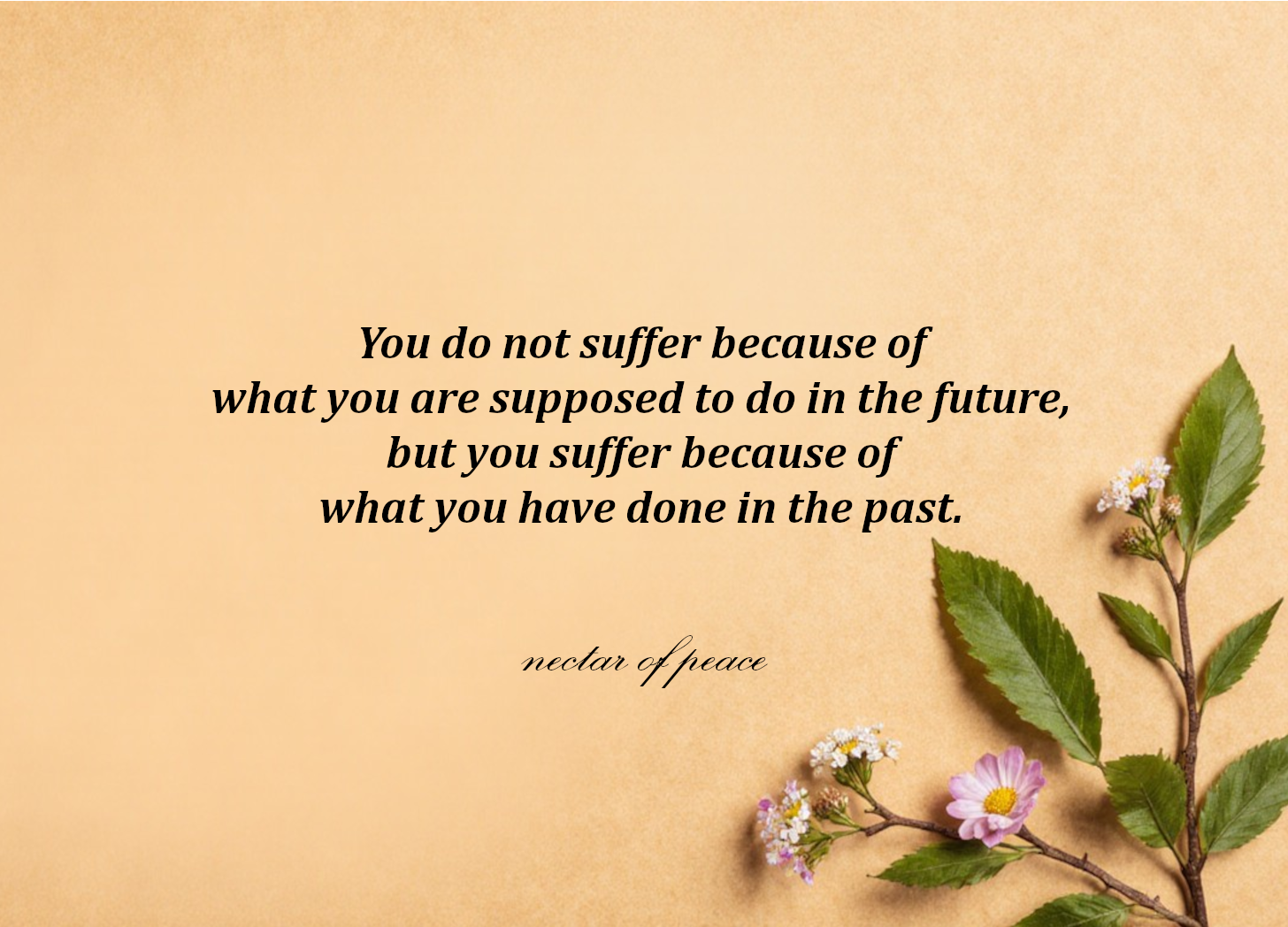
For you do not suffer because of what you are supposed to do in the future, but you suffer because of what you have done in the past. If you clear up the past, all your debts, mistakes, and the rest of it, you are free.
So be careful about what obligations you commit to, what you seek, because that is what will await you.«
Conclusion
With this important message, Novo also brings us to the end of this episode. And with that, I invite you to reflect on everything that has been shared and to meet some of the important questions that may arise from it. For example:
What brings me more peace … having more or fewer obligations?
Is any of my current obligations truly necessary?
And what would it mean if I gradually began renouncing new obligations?
From my own experience, I can say that as my wife and I try more and more to live only according to our needs and duties, and with as little planning and new obligations as possible, the more inner peace, contentment, and simplicity enter our lives. At the same time, we notice that life truly is designed only to be followed, not to be controlled, chased, or escaped from.
So may these teachings, these truths, and their internalization bring as much good and benefit as possible. And if you have any questions about the topics covered in this podcast, or if you’d like to have a more personal conversation with me about how to better internalize and apply them in your life, or if you just need some support, feel free to email me at mitja@nectarofpeace.com.
And if you found this episode interesting and helpful, I invite you to share it with others, possibly helping them to move toward a more spontaneous and peaceful way of living.
And once again, in the spirit of the Nectar of Peace, I send you greetings with the wish for peace.


