



🎧 Please listen to the audio using the player above.☝️
Episode 6: The True Meaning of “Being Here and Now” and Presence
In this sixth episode of the Nectar of Peace podcast, I will explore one of the most important concepts in spirituality: the state of mind in the “here and now,” or the state of presence. A clear understanding of this concept is essential for anyone on the path to peace, contentment, and well-being. And most importantly, as will also be mentioned in this episode, it leads us the true goal of life.
What you’ll hear in this episode:
The meaning of the concepts “here and now” and “there and now”
The meaning of the concept of presence
The state of non-thinking mind
The fundamental and true goal of life
My name is Mitja Žibert, and I’ll be your host on this podcast, which serves as an invitation to personal and spiritual growth.
Sources:
Novo: Lectures and Q&A archive
Satya Sai Baba: Book Sai Baba Speaks to the West
If you found this episode interesting and helpful, I invite you to share the show with others - you might just help someone on their path.
Episode transcription
Welcome to the sixth episode of the Nectar of Peace podcast, which is dedicated to sharing universal truths and wisdom taught by humanity’s greatest teachers and sages.
My name is Mitja Žibert, and I’ll be joining you in discovering these invaluable teachings that, if we choose to follow them, lead us to a life filled with the nectar of peace - which is what we all seek and need.
So, let’s see where we can discover and embrace it today.
Intro to Teachings
In the search for peace, contentment, and happiness, sooner or later almost everyone encounters the emphasis on the importance of “presence” and of “being here and now.” And while we’re quick to agree with this, since it sounds wise and meaningful, very few actually stop to truly realize what it means, or, since we agree with it, whether we know how to practice it and live it.
And that is precisely the focus of today’s episode: an explanation of the meaning of the state of “here and now” and of “presence”.
I didn’t have to look far for this explanation, as teacher Novo offered a clear answer to this question. To that, I will also add a few practical suggestions to help integrate his teaching more easily. And at the end of the episode, you’ll be met with a beautiful invitation to peace from the avatar Sathya Sai Baba.
Teachings
It is therefore best that we dive straight into the very essence of today’s episode. When asked the question, “What exactly does it mean to be ‘here and now’?”, Novo gave the following answer:
»Under the word now, it is understood that the mind is neither in the future nor in the past. That is the state of »now.«
The state of now applies when our mind is held only on what we are focused on. Only on that. The concept of now therefore means that there is no thinking about either the future or the past. That is “now”.
The concept of here, however, means that attention is within us, from the skin inward, no matter how deep.
I emphasize again: entering into ourselves means from the entire surface of the skin inward. So, not outward, but inward. Not behind us, not to the left or right, but directly inward. This means that our awareness is within the entire extent of the skin.
And if we have the ability to go even deeper into ourselves, then first all the internal organs are released, after which attention can turn to observing the mind, until thoughts disappear. At that point, we have neither thoughts nor emotions.
And having attention within us, a state of pleasantness arises. The deeper inside we are, the more this pleasantness increases. Presence within ourselves itself creates a true pleasantness. If the mind is not inside, this pleasantness is reduced or conditioned. It is therefore not comparable to when the mind is within us. The greatest pleasantness comes when the mind is within us, from the skin inward.
And so, when the mind is within us, and as said, it is then necessary to go even deeper - that represents the concept of “here”. Meanwhile, as we said, now stops time. This means that if you are not in the future or the past, you are in the present - it stops time.
If, however, you turn outward from yourself, outward from your skin, then you can be in the present, but you cannot be here. In that case, you will be outside yourself, and everything outside yourself is called there. So not here, but there.
It is called this way because, for example, if I am currently speaking to you or about you, I can be in the now, but I cannot be here, since my attention must be directed on you in order to see how you receive, perceive, and accept. And if I notice that your minds are bending aside, I must use explanations that keep your mind within the understanding. Therefore, when I attend to you, my attention must be there.
The same applies to you: when you want to do something, and what you want to do is outside of you - whether planting, mowing, writing, or reading—your mind must be there.
For example, if you need to write an informative text but your mind is inside yourself, your awareness and comprehension for writing the text fade away—you might even forget the alphabet, even your own first and last name ... meaning, you cannot produce the text.
So, in situations where you want to turn outward, your mind must be directed outward – in this example, toward the text, the work plan, the book, or whatever else.
And when the mind is there and in the present, you receive and comprehend directly. And if you then bring that back into yourself, you will once again return to here and now. But if you take it to someone else, you are now and with the other person - or now and there.
Thus, there is a difference between »here and now*«* and »there and now«.«
At this point, I want to draw attention to one important word that, throughout Novo’s explanation, never changes, and that word is »now«. Regardless of whether our attention is “here” or “there,” or whether we are in a state of inactivity or activity, the mind must remain in the “now.”
This is essential for truly understanding the meaning of presence. It represents a state of mind in which it is fully focused on what is happening at the moment. And this state of the mind is also a prerequisite for carrying out or understanding anything fully or totally.
The word presence therefore represents two distinct states of mind: “here and now” and “there and now.” Anything outside these cannot be considered presence.
Presence - and especially the state of here and now - is not some modern spiritual trend, but a fundamental and indispensable part of natural, inwardly peaceful, and healthy life. Thus, the path to such a life, as well as sustaining it, lies in continually bringing the mind back to itself.
Or, as Novo says:
“If the mind is kept in the here and now, then no matter what changes are taking place, the state of peace and inner peace remains unchanged. Thus, peace always and continuously exists as long as we can separate the mind from thoughts, or we make use of the non-thinking mind.
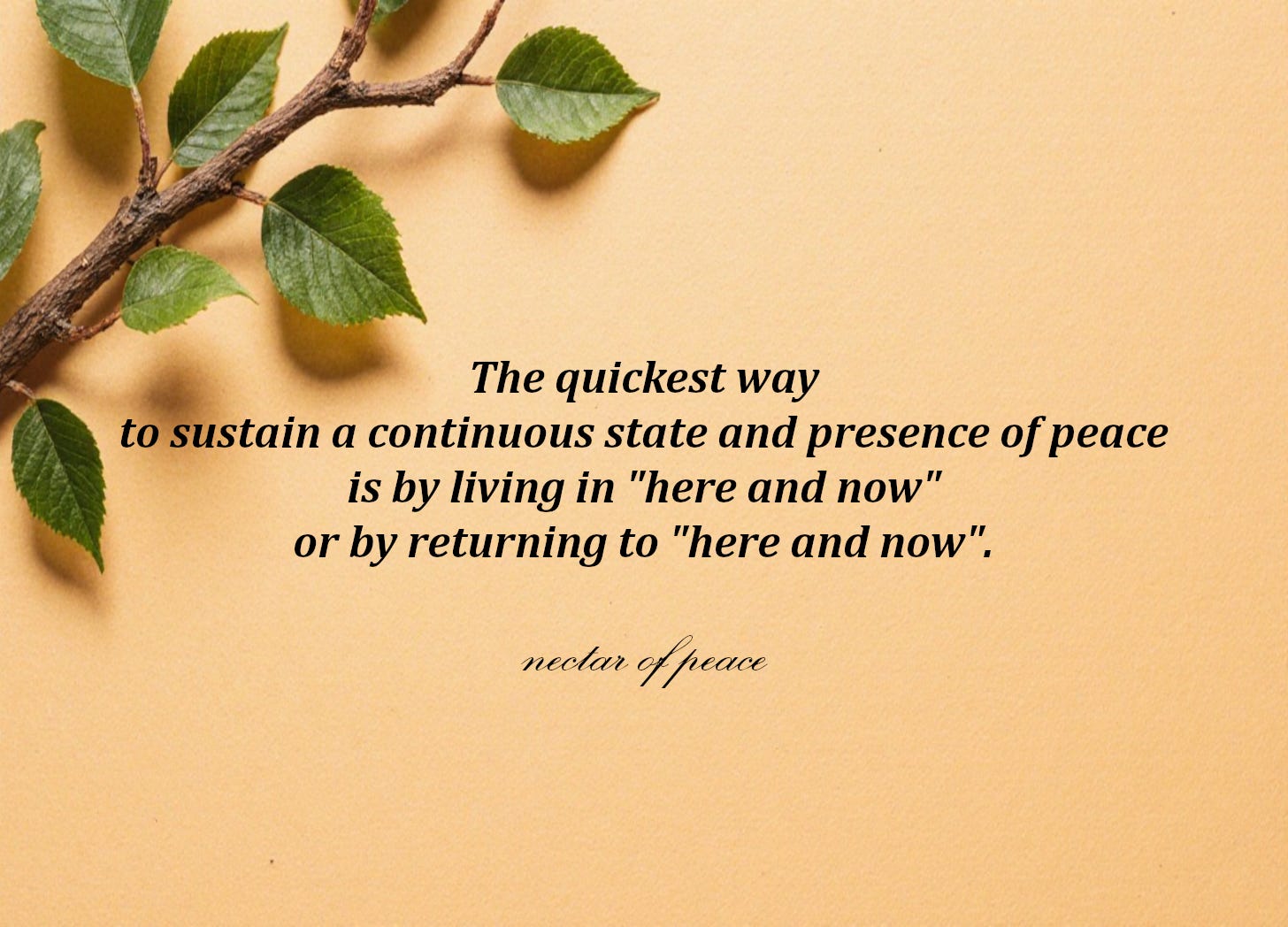
The quickest way to sustain a continuous state and presence of peace is by living in here and now or by returning to here and now. If the mind escapes from here and now, we must bring it back. If a person notices the mind has wandered from the here and now, they should return it. If it escapes again, they should return it again, and so on. The more often it is brought back, the more the intervals in which the mind does not wander gradually lengthen. In other words, the time of the non-thinking mind, or of the mind separated from thoughts, grows longer.”
At this point, Novo also spoke about one of the key states that anyone on the path to self-knowledge eventually reaches: the non-thinking mind. When asked what exactly this means, Novo replied:
“When we recognize within ourselves that the mind is in thoughts - and thoughts exist when one is thinking about the past or the future - we see, in such moments, that the mind is not only in the present. Because, in the present, the mind has no thoughts.
The term has no thoughts does not mean that we do not listen, watch, or similar. Rather, when a person is listening or watching something, no other thoughts should arise outside of what they are listening to or watching. If thoughts arise that are unrelated to what they are listening to or watching, then these are distracting thoughts.
When there is »me« and the object of observation, and other thoughts pass before me - and they, so to speak, prevent me from being continuously connected with the object of observation - then such mind is called the thinking mind. And it must be returned, meaning we must repeatedly return it to the object we are observing.
A thought, however, that is linked to what a person’s attention is focused on, is natural. It is completely natural to have such a thought, just as it is natural to watch or to listen. This is entirely normal. But when one is listening, one must listen only to that; when watching, one must watch only that.
If a person cannot free themselves from the thinking mind, then when they try to watch something, and when they do, other thoughts arise and disturb them.
It is therefore not necessary to remain completely without thoughts. It is true that one can reach such a state as well, but this requires reaching a higher level than that which is now. Such a state does exist. However, the state of the non-thinking mind is also considered as such when we are concentrated or focused, and there is nothing between us and the point of focus - or when we are connected with the object of watching or listening, and only we and the object exist. This state, too, is good.”
If all of this feels overwhelming or difficult, or if bringing the mind back to yourself or to a single object is something you are trying for the first time, I suggest starting slowly in the following way: take a few minutes when you know no one will disturb you. Close your eyes and relax. Then redirect the attention of your mind to your breathing … without trying to change or control it in any way. This means holding your attention entirely on the breathing. Simply observe the breathing, be aware of it … the inhale and the exhale, the touch of air in your nostrils, the movement of the body caused by breathing. Just observe, without controlling. And as soon as you notice that the mind has wandered, equanimously and with kindness to yourself bring it back to breathing.
Later, when you are able to keep the mind on the breath for a longer time, say for about a minute, you can shift this attention to bodily sensations. Start with the sensations on the surface and then gradually move to deeper, inner bodily feelings.
Dedicate some time for this … ideally every day, at the same time, for at least a few minutes. Let it become a regular daily activity.
This will however, at least at first, most likely feel extremely difficult and unfamiliar. The mind will indeed constantly wander in all directions, thinking about what to have for lunch today, or complaining about why the neighbor is mowing the lawn at this very moment, disturbing your observation of the breath. And on top of that, you might suddenly feel itches everywhere. All of this is a normal experience, and the only important thing is not to give up on yourself.
Let this practice truly become an important daily activity. At the same time, it should not become an empty routine, where you sit for five minutes with the aim of getting it over with as quickly as possible, and then after two minutes pat yourself on the shoulder, pleased with having completed this annoying task.
Instead, gift yourself these few minutes of the day and accept them as something genuinely meaningful. Let it be a time, regardless of the mind’s constant wandering, in which you each time sincerely and seriously intend to experience the true state of presence and, with it, peace.
Or, as Novo emphasized:
“… all the necessary and sufficient condition for maintaining peace is to live in the here and now. Or, if this state is lost, to return again to bringing the mind back to the here and now.”
With the concepts of presence, here, and now hopefully made somewhat clearer, let us briefly look a little deeper. As I have already mentioned, this is not some modern trend or triviality. These concepts are inseparably connected with the very meaning and purpose of our life. And Novo, for today only briefly, explains it like this:
“When we speak of here, it means precisely from here, where you came from. And from here, from where you came, where your being resides, here you are present. And when you are present there, from where you truly came, it becomes more and more pleasant - more pleasant and ever more pleasant.
And if you remain in the here and now continuously until the end, you will come to fully know yourself and everything that you are. And when even all of that is exhausted, in the end you come to an experience incomparable to anything else. You come to a kind of inner elation, to something that exists nowhere outside of you. At that moment, you also realize that you wish to return, because you know this is where you came from.
Thus, here and now means that you are at the point from which you truly originate, from where you truly came, and to where you can return.
This means that for your complete realization, for your full manifestation, for attaining the true goal, for returning to that goal, the only way is here and now.
From this, it becomes clear that a human being’s fundamental, unique, and primary goal is not to be occupied with things outside of oneself. That is not essential for human. As we have said, the discovery of the goal takes place in here and now, not in there and now.
For if you are not there, someone else will be. For example, if a person seeks help from someone, and that help is not received from that individual, it will be received from someone else. This means that matters concerning there are taken care of by someone else.
But when it comes to the question of ourselves, we must remain continually in here and now until we reach the end, our very being. And when we do reach our being, when we have returned to where we truly are, when we know from where we come and where our true existence lies - by knowing this, we can then return and engage with there and now.
Then, if you wish, you can use there and now to help another without wrongdoing, because by that point you have already fulfilled and realized here and now.
It is like, for example, two people going to a certain place. One of them knows the way to this place, and therefore has no need to ask either for directions or about the place itself, because he knows the way. There is no need for him to search. Thus, the one who knows this and also knows approximately how long the journey will take, can afford some luxury. He can linger elsewhere, because he knows the way.
But the one who doesn't know the way, and therefore probably doesn't know how long the journey might take, this one will wander. And if he also allows himself the luxury by thinking, “I have time to find this place,” it may turn out that, although the path itself could be short, since he does not know where to go, he will have to search in all directions … left, right, back, forward and in doing so, he will lose the way.
And unlike the one who knows the way and for whom it may be short, for the one who does not know it, the path will turn out to be very long. And in this way, he will lose his entire life.
That is why a human must know that one must first live in here and now, and only then in there and now.«
Let me add here that by this, Novo does not suggest that, for the sake of living in here and now, we should neglect our duties. What is meant by the statement that one must first live in here and now, and only then in there and now is that it is best to dedicate all of our free time to here and now. When, however, we have duties that we must attend to, we naturally shift into there and now. And once those duties are completed, it is best to return once again to here and now.
If we manage to live in this way, and also carry out our duties in this way, we may notice that the number of duties gradually decreases and the time available for here and now grows. And if we truly use this time as intended, the depth of penetration into ourselves also increases.
It is clear, however, that such a way of living is extremely unfamiliar and difficult for a person who constantly lives in the mind. If we simply reflect on the usual state of our mind, its restlessness and the endless stream of thoughts, we can quickly realize that holding attention in here and now is indeed the hardest thing.
Namely, our thinking mind is extremely powerful and, most of the time, it controls us rather than the other way around. Or as the wisdom goes: “The thinking mind is a useful servant, but an extremely harmful and dangerous master.” If we are its servant, which most of us are, it constantly pulls us from the future to the past and back again, from one activity to another, from one person to another, from one worry to another, from one fantasy to another, from one problem to another, and so on. Even saying this out loud is exhausting, let alone the unimaginable waste of energy caused by our constant and unnecessary thinking.
And it is precisely the thinking mind that continuously drains one's energy and, at the same time, leads us away from what can truly bring peace, contentment, and happiness.
Therefore, anyone who has truly resolved to bring peace and contentment into their life will sooner or later realize that these cannot be found outside ourselves, for the external is not dependent solely on us and is constantly changing. Moreover, it is not the true source of our energy; rather, it is where our energy is being spent.
And it is exactly this returning to oneself and to the recognition of our origin that Novo highlights as the fundamental purpose of our life. In a similar way, Sai Baba invites us to recognize the goal of our life within ourselves, rather than looking outside ourselves. As he put it:
»Always keep in mind that it must be your goal to live entirely without aggression: in peace with yourself and therefore with your fellow man and your environment.
See and respect God in everything and in all people, and you will feel how your life changes.
Happiness and peace will enter you, and you will experience the unity of creation more and more.
This is peace. This is bliss. This is the fulfillment of your life which you have been searching for unsuccessfully long enough, somewhere else.«
Conclusion
With this beautiful invitation to return to ourselves, Sai Baba also brought us to the end of this episode. And with that, I am certain he would encourage you, once the episode ends, to devote at least a few minutes of your full attention to the “here and now.”
Of course, as I mentioned earlier, the beginning of the path towards “here and now” can be very challenging, since the restless mind constantly pulls us outward and away from the present. But, as Novo said, the more often we bring the mind back, the more this habit, and the restlessness, begin to soften, making entry into the state of true presence easier and more accessible. So never give up - instead, we must continue with courage and trust … step by step … breath by breath … until at last, we breathe in the fragrance of the true nectar of peace.
If you have any questions about the topics covered in this podcast, or if you'd like to have a more personal conversation with me about how to better internalize and apply them in your life, or if you just need some support, feel free to email me at mitja@nectarofpeace.com.
And if you found this episode interesting and helpful, I warmly invite you to share the episode with others, and perhaps help them experience more frequent moments of presence.
And once again, in the spirit of the Nectar of Peace, I send you greetings with the wish for peace.


