



🎧 Please listen to the audio using the player above.☝️
In the eighth episode of Nectar of Peace, we will explore the origin of feelings of disappointment and dissatisfaction. At the same time, we will discover an important key to easing, or even better, to avoiding them as much as possible. And to bring a little laughter, I’ve added a joke that nicely complements today’s lesson.
What you’ll hear in this episode:
The two-sidedness of life – inner and outer consciousness
Where to seek true contentment and happiness?
Hidden, rapidly growing progress
Nothing is lost
The importance of inner experience
My name is Mitja Žibert, and I’ll be your host on this podcast, which serves as an invitation to personal and spiritual growth.
Sources:
Novo: Lectures and Q&A archive
If this episode resonated with you, consider sharing it with friends or loved ones - you might just help someone on their path.
Episode transcription
Welcome to the Nectar of Peace podcast, which is dedicated to sharing universal truths and wisdom taught by humanity’s greatest teachers and sages.
My name is Mitja Žibert, and I’ll be joining you in discovering these invaluable teachings that, if we choose to follow them, lead us to a life filled with the nectar of peace - which is what we all seek and need.
So, let’s see where we can discover and embrace it today.
Life, as most of us know it, inevitably brings disappointment and discontent. Some experience it less, others more. For some, these feelings arise more often, for others less so. And similarly, for some, they come sooner, for others, later. Yet no matter how much or when they occur, these are the feelings that no one truly wishes to feel.
That is why, in today’s episode, I’ll explore the source of these negativities. Understanding their origin is key to overcoming them, or even better, to avoiding them as much as possible.
And once again, we will find that the same culprit is behind this, just as in all the other troubles that accompany humanity throughout life. To reveal this culprit, we turn once more to teacher Novo, who offers an explanation unfolding across several layers of understanding, through both practical examples and deeper, subtler truths.
So, if any part of it doesn’t seem clear at first, don’t worry. Take your time to let it sink in, and feel free to return and listen again if needed.
It is also worth noting that today’s answer applies both to our external, material experiences and to our inner, spiritual ones. In other words, it can help us find success in both material and spiritual growth. In either case, disappointment and discontent signal that somewhere along the way, we’ve lost touch with this important key to happiness and fulfillment.
And Novo presents this key in two parts. The first part addresses the two-sidedness of our lives and the importance of giving attention to both sides. The second part reveals the essential element needed to manifest what we truly desire as individuals.
Novo shares the first part, the two-sidedness of our lives, as follows:
Teachings
“Reality and real life inevitably come to an end in time. If a person truly lives in reality, sooner or later they will face ultimate disappointment. Why? Because for us to be satisfied with anything, we would need to be able to hold it still, to keep it frozen in time for as long as we wish. But life is not still. We cannot stop life. It is life that leads us, not we who lead it. If we look at how life leads us, we can see that this means that, if we live rightly, we remain content no matter where life takes us.
But if, at some point, we try to lead life ourselves, then the way of living that we plan and follow, all the possibilities, all the directions, everything we take upon ourselves, inevitably ends in complete collapse or definitive disappointment.
And ultimately, that is the whole point: that a person comes to realize there is nothing in life. That one comes to see that, apart from disappointment, life holds nothing else.”
Let me add here that this once again highlights the importance of living by duties rather than by obligations. Which is what we explored in greater detail in the previous episode.
Here, Novo continues that…
“… a person must therefore understand that as their consciousness and awareness grow, the greater the consciousness and the purer the intelligence, the more clearly they see that life is only temporarily present, and that we cannot bring it to a halt. For the greatest problem in life is precisely this: we cannot stop it.
Yet a person finds satisfaction only in what seems to stand still in time, in something that endures forever or infinitely. That is what humans long for, but life itself is not like that. For when we live through outer consciousness, that consciousness ends with the death of the body.
With inner consciousness, or balance, however, even when the body comes to an end or despite the passing of years, consciousness remains. This continuation of consciousness is somewhat like what happens when a person falls asleep at night. When one falls asleep and begins to dream pleasant dreams, they do not complain about having fallen asleep or about having lost something. In the same way, after death, new perspectives and new manifestations appear.
For example, suppose we are sitting in a room and someone leaves it. During their absence, even if only for a brief time, they are, for us, dead, inaccessible. And when someone is inaccessible, whether for two minutes or for one, two, five, or ten lifetimes, there is no difference.
The difference arises only when consciousness is interrupted, and this happens only when it is external. Such consciousness is interrupted because the external changes forms, changes the body, changes circumstances, and so on. This creates an unwanted pause.
So, regardless of how many years a person lives, be it a hundred, two hundred, three hundred, or a thousand years, the problem is that when consciousness is external, one lives dependent on changing conditions. This means that growing up, they are dependent on others, because they are powerless. Likewise, when injury or illness occurs. This is also unwanted. And in old age, again, one is powerless.
Thus, only a brief period of life, the period of maintenance that comes after maturity and before old age, so, a very small portion of life, is when a person can truly feel that life is beautiful or that they like it. After that, all of it is lost.
And the fear of having to experience this again through lifetimes, through rebirth, going through the same powerlessness experienced before, through aging, old age, and death, is perceived by external consciousness as that life is suffering.
With inner consciousness, however, a person observes the external world without attachment. They are aware that the external world is slipping away and is impermanent. One can easily recognize that if consciousness exists only externally, both such consciousness and the external world can always be lost, and they will be gone.
Therefore, if a person does not learn to turn inward, they truly do not know how or what to do, and various unpleasant experiences arise, experiences they would rather not have. For humans, with their unique ability to live consciously are after all immortal beings. The physical body, however, is not immortal; it constantly changes. Even within a lifespan of a hundred years, we can see that we are never the same as when we were two, three, four, five, six, fifteen, twenty, ninety, or ninety-nine.
A person cannot boast of having lived a hundred years. And what if they have lived a hundred years? Perhaps in those hundred years, they did not live spiritually even for two. What kind of life they lived for hundred years? So, one cannot boast that living outwardly, through the body, is sufficient. It is not sufficient!
And that is that, when people lost the meaning of life and, in doing so, moved into an unwholesome way of living and developing. For if a person loses their inner consciousness, it is far more dangerous than losing their sight. If one loses sight but consciousness remains, that consciousness exists and knows that it exists. But if a person loses consciousness, even with perfect sight, they are unhappy and errant, for they do not know what to do with their vision. It is no wonder, then, that such a person experiences conflict: lacking inner consciousness, they see, yet are neither content nor happy. Thus, when they say, “I will go to sleep to rest,” even in sleep, seeing nothing, they feel more content than when they are looking.”
As we have seen in this first part, a partial source of our disappointment and discontent lies in our lack of turning inward and, through that, in our lack of discovering our inner consciousness. This is not at all surprising, since even the most basic awareness of this has almost vanished today, let alone the knowledge of the path that leads to inner consciousness. Therefore, I will explore this path, this turning inward, which is emphasized in all spiritual teachings and traditions, in greater detail, probably in the next episode. In doing so, I will try to explain what turning inward truly means and how we can approach it in practice.
For now, let us continue with the second part, in which Novo unites both outer and inner consciousness, the material and the spiritual, and in doing so, offers practical guidance on how to avoid further disappointment and discontent. He says the following:
“The problem is that all forms of upbringing, education, and proper guidance of the generations being born, so that they may live righteously, have been discarded. Yet, despite this, it is important to remember that this way of living, which makes people unhappy, can be changed. This has been demonstrated by great individuals who have shown that life can also be happy, not only unhappy.”
Let me clarify here that when Novo speaks of happiness or a happy life, he means a life in which a person is lastingly happy, at peace, and wholly content: both with themselves and with all the circumstances. In other words, the term happiness here is not used in a superficial sense, nor as a fleeting feeling of satisfaction.
And so, Novo continues, that …
“… these great individuals have shown that life does not depend on external consciousness, but rather on the consciousness directed toward ourselves, toward our actions, and consciousness directed toward others, toward how we behave with them. It depends on this, and when this is corrected, our life gradually begins to change for the better.
At the same time, one infinite panorama of experience and awareness begins to open, through which life continues into a new way of understanding and experiencing. And this new way of experiencing is not lost … not in death, nor in any other circumstances.”
What this reveals is, that a person can indeed be content, but for this, they must adjust, correct, and improve their way of living. This means having awareness of both external circumstances and one’s inner processes, one’s own behavior, and one’s own responsibility.
This, then, can be corrected, if a person decides to correct themselves. And although at first this process of self-correction may seem too distant or too long, there exists one not so obvious progression, known in mathematics as geometric growth, which has an accelerating effect. Unlike arithmetic growth, which is linear and increases by the same amount each time, geometric growth, even if the content remains the same, expands in ever larger steps.
Such, too, is spiritual progress. Once a person begins, what initially seemed inaccessible gradually, through steady effort, becomes something wondrous and spectacular, as one realizes that it can be reached much sooner than one first believed, when it all seemed so far away.
In spirituality, then, there exists this hidden, rapidly accelerating kind of progress. That is why it is important to understand that a person can never say they have started too late. They simply cannot say that. They may have begun later in time than they could have, but if they persist and continue without interruption, they will see that the feeling of being “late” existed only at the beginning. With each new step, that feeling fades.
And when one reaches the point where an unplanned change of an unforeseen nature occurs, something happens that is beyond explanation. Something that people often attribute to God, saying, “God helped me.” That is indeed true, but the condition for God to be able to help is that a person must first begin to change themselves.”
This part, in fact, reminds of an old joke, which is not merely a joke, but carries an important lesson about how any goal or wish can be realized.
And the joke goes like this:
A very devout person prayed to God every day, saying,
“Please, God, let me win the lottery! Please, just grant me this one wish!”
Day after day, year after year, for decades he kept praying, but never won.
When his life finally came to an end and he met God, he asked,
“God, I prayed all my life! Every night I asked to win the lottery, yet you never answered my prayers. Why? Was I not faithful enough?”
God replied,
“Ah yes. Yes, you were faithful enough, and I would even have answered your prayer… but you could have at least bought a lottery ticket!”
And that is why every step we take toward our goal is like a winning lottery ticket, for with it, knowingly or unknowingly, we draw closer to that goal.
At the same time, it is important to remember what was said earlier: as long as a person pursues only external, material goals without including the spiritual dimension and the inner development of life, they will inevitably remain empty and disappointed, even if those goals are achieved. For it is the spiritual dimension that breathes life into everything. Without it, even a materially full and abundant life is empty and lifeless, and eventually dissolves.
It is precisely this tragedy of many people that Novo emphasizes in the continuation:
“There is, therefore, no room for pessimism or disappointment. But this applies only within the realm of spirituality. In the material world, this is not so. When a person builds in the material and remain only with external consciousness, they must watch with their own eyes how what they have invested their time, effort, and far more into than they ever expected, begins to crumble before them. Before their own eyes, they kill it. Before their own eyes, they are powerless to stop what they had once hoped would serve them. And here, it concerns living people, not just material things or objects.”
This arises from the lack of restored awareness of themselves … of their mind, of the mind’s functions, and of the awareness of a deeper, broader existence within us that extends far beyond what the physical body can provide.
All of this shows that there is truly no room for disappointment or discontent. And for this, the only requirement is that a person also connects with spirituality.
As we have said, non-spirituality takes away at least fifty percent, leaving the other fifty percent to be used. In spirituality, however, you have one hundred percent. This is because non-spirituality covers only the external side, whereas spirituality teaches that both sides form a whole and that together they are one. Therefore, one cannot hold on to just one side; one must understand that the two sides are connected. And because they are connected, a person who grounds themselves in spirituality is granted a life free from worry, danger, and suffering.”
Here, Novo finally identifies the very culprit mentioned in the introduction as the source of human suffering - and that is our mind, or more precisely, our lack of awareness of how the mind functions and our improper use of it. As I mentioned in one of the previous episodes, our mind can be an extraordinarily helpful servant, yet an equally dangerous master. Through the mind, we can achieve literally anything, and through it, we can also destroy everything.
For this very reason, each of us bears full responsibility for our actions and their consequences, since all of it stems from our own mind.
Between our mind and our happiness or discontent, there exists another key element, which Novo masterfully weaves into the whole as follows:
“What we desire can only be achieved individually and never through another. It cannot be done by someone else, but solely through ourselves. And that is how it is!”
It is the same as if a person were to eat something poisonous, it is not the neighbor, brother, or father who will be poisoned, but the one who actually ate it. And the same applies here. A person must therefore realize that, in order to experience well-being, they must pay attention to their own proper conduct toward themselves. For if they do not, no one from the outside can help them, not doctors, not gurus, no one can help them. This is because the reason a person suffers originates from their own mind, and their mind is precisely as they have shaped it. Only the one who has distorted the mind can also correct it.
But why is this so? Let me give a simple example to explain why no one can change another person’s mind:
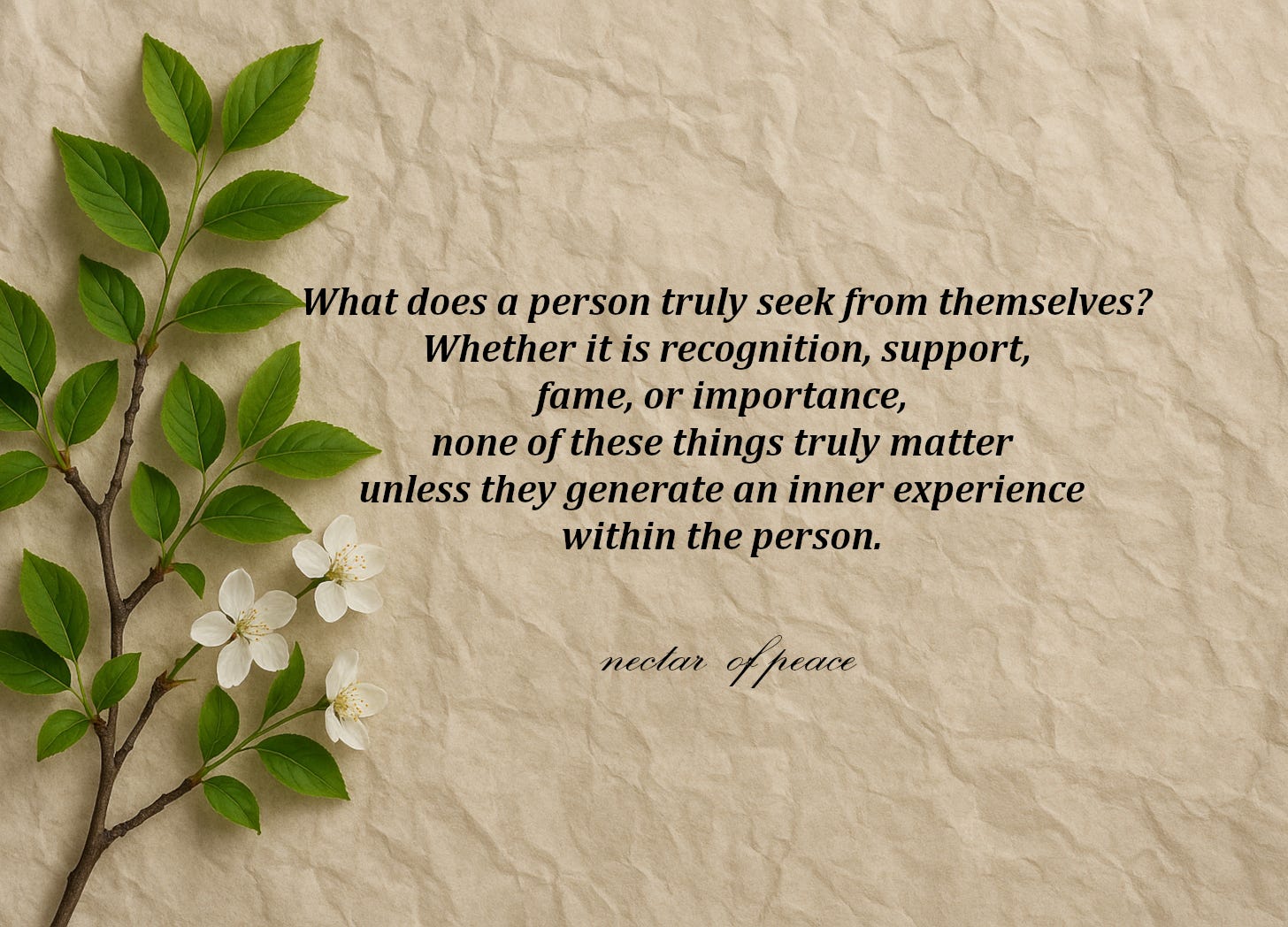
What does a person truly seek from themselves? Whether it is recognition, support, fame, or importance, none of these things truly matter unless they generate an inner experience within the person. For instance, someone might praise us, but if that praise does not create an inner experience, it is meaningless, we are worth nothing.
And what does this mean? It means that we value only the circumstances that bring about experiencing and experience within us. This experiencing is what is called manifestation or actualization.
For if I don’t actually do something myself, it doesn’t matter how many awards or recognitions I receive, they will not create any experience within me. In other words, it doesn’t matter how much someone praises me for being a good athlete or anything else.
If I haven’t mastered the sport to the level for which I’m praised, meaning I haven’t actually demonstrated it, I cannot feel content, because I lack the actual experience.
Or to give an even simpler example: suppose I won a huge sum in the lottery, but I never actually received the money. It’s the same principle. If someone thinks they have won but, in reality, has not, they gain no experience. But the person who actually receives the prize has the experience.
Therefore, a person must realize that what they are truly seeking is experience. Humans can retain only experience, and find contentment in what they have truly experienced. And the experience is called transformation or manifestation. In other words, one must undergo a transformation in order to have the experience.
For example, we might have some delicious food, but if we don’t actually eat it, we won’t have the experience and, consequently, won’t feel content.
The same applies when a person wants to be spiritual: they must manifest it. In other words, spirituality, too, requires manifestation. Or consider someone who wants to drive a car: if they do not actually manifest the act of driving, what use is the car to them?
And manifestation itself is created by our own mind. This means that our mind transforms us into what we wish to be. It transforms us. But if our mind manifests us into something we do not wish to be, it will destroy us - we will suffer, fall ill, and so on. That is why a person must understand that it is manifestation that we are truly seeking.
This means that if we want to achieve something, we must manifest it and work on it. Without this, there is nothing. And by “nothing,” we mean that the experience we desire does not exist within us.
Again, I emphasize: this is created by our mind. We must also realize that our mind can either corrupt and destroy us, or it can uplift us, make us happy, smart, successful, and even enlighten us.
This is the difference, and a person must know that manifestation gives experience, and manifestation is created by the mind. That is why each person must correct and transform themselves.”
With this, Novo reminded us that without the experience arising from the actual manifestation of what we desire, there can be neither contentment nor happiness. But for manifestation to occur, we must invest effort and be persistent. And the power for both lies entirely within our own mind, and it is entirely up to us how, when, and why we use this power. As emphasized earlier, it is particularly important that we also direct this power toward our inner consciousness.
Conclusion
And with that, we come to the end of today’s episode. I would like to once again invite to reflection on the fact that merely dreaming about fulfilling a desire or achieving a goal is one thing, but quite another is whether we have truly earned the manifestation of that desire and the experience it brings, through our own actions, effort, and persistence. This question should accompany every moment of disappointment and discontent.
So, if you feel disappointed over something, or if you’ve been putting something off, go ahead and take the first step toward it with courage. Then, step by step, move from the beginnings of transformation toward the true experience of contentment and fulfillment.
I truly hope that these teachings, these truths, and their internalization bring you as much good and benefit as possible. And if you have any questions about the topics covered in this podcast, or if you’d like to have a more personal conversation with me about how to better internalize and apply them in your life, or if you just need some support, feel free to email me at mitja@nectarofpeace.com.
And if you found this episode interesting and helpful, I invite you to share it with others, possibly helping them to move toward a life of contentment and fulfilment.
And once again, in the spirit of the Nectar of Peace, I send you greetings with the wish for peace.


